




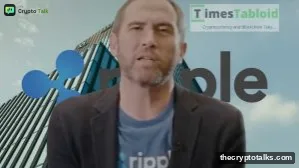
Crypto commentator Zach Humphries recently drew attention to a significant remark from Ripple CEO Brad Garlinghouse through a video shared on X.
The CEO explained the reasons behind XRP’s struggles, pointing out that two high-profile IPOs diverted capital away from the digital asset markets, contributing to the recent weakness in XRP’s valuation.
These remarks were made during an interview with a Bloomberg host at the Singapore Fintech Festival, where Garlinghouse was pressed on a query that XRP holders have raised for months: why is Ripple’s corporate business expanding while XRP’s price lags?
WHAT JUST HAPPENED?
RIPPLE CEO GIVES UNEXPECTED ANSWER ABOUT XRP WHICH HAS PEOPLE ASKING MAJOR QUESTIONS!
DON'T MISS WHAT BRAD GARLINGHOUSE JUST TOLD BLOOMBERG AND WHAT THIS MEANS FOR XRP! pic.twitter.com/nZRMqI5bhn
— Zach Humphries (@ZachHumphries) November 25, 2026
Garlinghouse Points to Capital Outflows
Garlinghouse provided two key insights. Acknowledging that cryptocurrency functions as a risk-on asset, he connected XRP’s underperformance to a pair of major stock market listings. “When the SpaceX IPO happened, there was a big downdraft as people used the liquidity in the crypto markets,” he stated.
He noted further that the Anthropic IPO generated “almost an identical behavior.” In his assessment, investors liquidated their cryptocurrency holdings to gather funds for participation in those public offerings. Humphries supports parts of this logic, observing that the broader artificial intelligence sector successfully pulled both attention and capital away from the crypto space.
Furthermore, he points out that market participants sold off equity positions in companies such as Nvidia and Micron to finance these ventures, though he hesitates to accept Garlinghouse’s explanation as fully comprehensive.
Where Humphries Pushes Back
Humphries concurs that cryptocurrencies thrive best in conditions characterized by excess liquidity, low interest rates, and active monetary expansion. He views the current market contraction as part of a broader risk-on/risk-off cycle rather than an issue isolated to XRP. However, his primary critique is that Garlinghouse avoided a direct answer to the fundamental question.
The inquiry Humphries most wants addressed is whether RLUSD, the stablecoin issued by Ripple, has changed XRP’s role in cross-border payments. Following the passage of the Genius Act, RLUSD serves as a viable alternative in scenarios where XRP was previously the exclusive option. “In what instances would XRP be used? In what instances would RLUSD be used?” Humphries questions.
An Upcoming Shift
During the Bloomberg interview, Garlinghouse predicted that investors will observe a growing divergence among various crypto assets in the years ahead, with utility-driven tokens outperforming those fueled purely by speculation. Humphries also highlighted the firm’s push toward becoming a crypto bank, though he argues this development introduces new inquiries regarding the future function of XRP.
Humphries’ Position on XRP Now
Currently, Humphries maintains 70% of his portfolio in cash. He states that if XRP pulls back to $0.70 or $0.80, he intends to begin accumulating aggressively. Having built up large positions between $0.40 and $0.50 during 2022 and 2023, he previously locked in profits as XRP surged from $0.45 to over $3.
He plans to implement this strategy once again. In the interim, he views patience as the correct approach and advises the community to monitor price movements closely.
Frequently Asked Questions
Why did Ripple CEO Brad Garlinghouse say XRP’s price has been struggling?
Garlinghouse stated that capital was pulled away from the cryptocurrency markets by two high-profile public offerings—specifically the SpaceX IPO and the Anthropic IPO—causing investors to tap into crypto liquidity.
What are Zach Humphries’ main criticisms of Garlinghouse’s explanation?
While Humphries agrees that broader capital trends and AI trades have pulled money away from crypto, he believes Garlinghouse did not directly answer whether Ripple’s new stablecoin, RLUSD, alters XRP’s traditional role in cross-border payments.
How is Zach Humphries currently approaching his XRP investments?
Humphries is holding 70% of his capital in cash, waiting to see if XRP drops to the $0.70 or $0.80 range before buying back in aggressively, mirroring his accumulation strategy from 2022 and 2023.
Explained in this article
Cryptocurrency
A digital currency secured by cryptography and recorded on a blockchain, without a central bank issuing it.
Crypto prices are volatile, and governments are still deciding how to regulate it.
More about CryptocurrencyInitial public offering
The first sale of a private company's shares to the public, after which the shares trade on a stock exchange.
An IPO raises money for the company and lets early owners and investors sell part of their stake.
More about Initial public offeringArtificial intelligence
Computer systems that perform tasks that normally require human intelligence, such as understanding language, recognising images or making decisions.
AI is changing work, media and public services, raising questions about jobs, safety and regulation.
More about Artificial intelligenceStock market
The set of exchanges where shares of public companies are bought and sold.
Market moves reflect investor expectations about companies and the economy, and affect savings and pensions.
More about Stock market
Written by
 Elara Winter
